
a project by 3nd5h1771fy
Description
The Mission: Decentralized & Sovereign Messaging
FYI: If you have never heard of "Chatmail", you can visit their site here, but simply put it can be thought of as the underlying protocol/platform decentralized messengers like DeltaChat use for their communications. Do not confuse it with the honeypot looking non-opensource paid for prodect with better seo that directs you to chatmailsecure(dot)com
In an era of increasing centralized surveillance by unaccountable bad actors (aka BigTech), "Chat Control," and the erosion of digital privacy, the need for sovereign communication infrastructure is critical. Chatmail is a pioneering initiative that bridges the gap between classic email and modern instant messaging, offering metadata-minimized, end-to-end encrypted (E2EE) communication that is interoperable and open.
However, unless you are a seasoned sysadmin, the current recommended deployment method of a Chatmail relay is rigid, fragile, difficult to properly secure, and effectively takes over the entire host the "relay" is deployed on.
Why This Matters
A simple, host agnostic, reproducible deployment lowers the entry cost for anyone wanting to run a privacy‑preserving, decentralized messaging relay. In an era of perpetually resurrected chat‑control legislation threats, EU digital‑sovereignty drives, and many dangers of using big‑tech messaging platforms (Apple iMessage, WhatsApp, FB Messenger, Instagram, SMS, Google Messages, etc...) for any type of communication, providing an easy‑to‑use alternative empowers:
- Censorship resistance - No single entity controls the relay; operators can spin up new nodes quickly.
- Surveillance mitigation - End‑to‑end OpenPGP encryption ensures relay operators never see plaintext.
- Digital sovereignty - Communities can host their own infrastructure under local jurisdiction, aligning with national data‑policy goals.
By turning the Chatmail relay into a plug‑and‑play container stack, we enable broader adoption, foster a resilient messaging fabric, and give developers, activists, and hobbyists a concrete tool to defend privacy online.
Goals
As I indicated earlier, this project aims to drastically simplify the deployment of Chatmail relay. By converting this architecture into a portable, containerized stack using Podman and OpenSUSE base container images, we can allow anyone to deploy their own censorship-resistant, privacy-preserving communications node in minutes.
Our goal for Hack Week: package every component into containers built on openSUSE/MicroOS base images, initially orchestrated with a single container-compose.yml (podman-compose compatible). The stack will:
- Run on any host that supports Podman (including optimizations and enhancements for SELinux‑enabled systems).
- Allow network decoupling by refactoring configurations to move from file-system constrained Unix sockets to internal TCP networking, allowing containers achieve stricter isolation.
- Utilize Enhanced Security with SELinux by using purpose built utilities such as udica we can quickly generate custom SELinux policies for the container stack, ensuring strict confinement superior to standard/typical Docker deployments.
- Allow the use of bind or remote mounted volumes for shared data (
/var/vmail, DKIM keys, TLS certs, etc.). - Replace the local DNS server requirement with a remote DNS‑provider API for DKIM/TXT record publishing.
By delivering a turnkey, host agnostic, reproducible deployment, we lower the barrier for individuals and small communities to launch their own chatmail relays, fostering a decentralized, censorship‑resistant messaging ecosystem that can serve DeltaChat users and/or future services adopting this protocol
Resources
- The links included above
- https://chatmail.at/doc/relay/
- https://delta.chat/en/help
- Project repo -> https://codeberg.org/EndShittification/containerized-chatmail-relay

Looking for hackers with the skills:
selinux podman postfix dovecot python go docker-compose automation systemd containers security
This project is part of:
Hack Week 25
Activity
Comments
Be the first to comment!
Similar Projects
Rejuvenate the Postfix package by varkoly
Description
The setup script of postfix /usr/sbin/config.postfix is very old and very often causes problems. We need to discuss whether we need such a script at all. Postfix is extremely complex. Configuring everything via scripts and sysconfig variables is impossible and ultimately does not make things any easier. It is difficult to decide what should be configurable in this way and what should not. Since openSUSE/SLES 16.0, there is no longer a graphical tool that would really simplify configuration. Furthermore, the basic configuration of Postfix is a one-time task that requires a great deal of expertise. During operation, only the postmaps need to be maintained.
Goals
The main goal is to deliver a robust postfix package which works out of the box and the updates can not break the configuration.
Resources
I am looking for openSUSE/SLES users who use Postfix intensively and have clear expectations regarding Postfix maintenance. The only resource I need is ideas.
Improve chore and screen time doc generator script `wochenplaner` by gniebler
Description
I wrote a little Python script to generate PDF docs, which can be used to track daily chore completion and screen time usage for several people, with one page per person/week.
I named this script wochenplaner and have been using it for a few months now.
It needs some improvements and adjustments in how the screen time should be tracked and how chores are displayed.
Goals
- Fix chore field separation lines
- Change screen time tracking logic from "global" (week-long) to daily subtraction and weekly addition of remainders (more intuitive than current "weekly time budget method)
- Add logic to fill in chore fields/lines, ideally with pictures, falling back to text.
Resources
tbd (Gitlab repo)
Improve/rework household chore tracker `chorazon` by gniebler
Description
I wrote a household chore tracker named chorazon, which is meant to be deployed as a web application in the household's local network.
It features the ability to set up different (so far only weekly) schedules per task and per person, where tasks may span several days.
There are "tokens", which can be collected by users. Tasks can (and usually will) have rewards configured where they yield a certain amount of tokens. The idea is that they can later be redeemed for (surprise) gifts, but this is not implemented yet. (So right now one needs to edit the DB manually to subtract tokens when they're redeemed.)
Days are not rolled over automatically, to allow for task completion control.
We used it in my household for several months, with mixed success. There are many limitations in the system that would warrant a revisit.
It's written using the Pyramid Python framework with URL traversal, ZODB as the data store and Web Components for the frontend.
Goals
- Add admin screens for users, tasks and schedules
- Add models, pages etc. to allow redeeming tokens for gifts/surprises
- …?
Resources
tbd (Gitlab repo)
Update M2Crypto by mcepl
There are couple of projects I work on, which need my attention and putting them to shape:
Goal for this Hackweek
- Put M2Crypto into better shape (most issues closed, all pull requests processed)
- More fun to learn jujutsu
- Play more with Gemini, how much it help (or not).
- Perhaps, also (just slightly related), help to fix vis to work with LuaJIT, particularly to make vis-lspc working.
Liz - Prompt autocomplete by ftorchia
Description
Liz is the Rancher AI assistant for cluster operations.
Goals
We want to help users when sending new messages to Liz, by adding an autocomplete feature to complete their requests based on the context.
Example:
- User prompt: "Can you show me the list of p"
- Autocomplete suggestion: "Can you show me the list of p...od in local cluster?"
Example:
- User prompt: "Show me the logs of #rancher-"
- Chat console: It shows a drop-down widget, next to the # character, with the list of available pod names starting with "rancher-".
Technical Overview
- The AI agent should expose a new ws/autocomplete endpoint to proxy autocomplete messages to the LLM.
- The UI extension should be able to display prompt suggestions and allow users to apply the autocomplete to the Prompt via keyboard shortcuts.
Resources
Collection and organisation of information about Bulgarian schools by iivanov
Description
To achieve this it will be necessary:
- Collect/download raw data from various government and non-governmental organizations
- Clean up raw data and organise it in some kind database.
- Create tool to make queries easy.
- Or perhaps dump all data into AI and ask questions in natural language.
Goals
By selecting particular school information like this will be provided:
- School scores on national exams.
- School scores from the external evaluations exams.
- School town, municipality and region.
- Employment rate in a town or municipality.
- Average health of the population in the region.
Resources
Some of these are available only in bulgarian.
- https://danybon.com/klasazia
- https://nvoresults.com/index.html
- https://ri.mon.bg/active-institutions
- https://www.nsi.bg/nrnm/ekatte/archive
Results
- Information about all Bulgarian schools with their scores during recent years cleaned and organised into SQL tables
- Information about all Bulgarian villages, cities, municipalities and districts cleaned and organised into SQL tables
- Information about all Bulgarian villages and cities census since beginning of this century cleaned and organised into SQL tables.
- Information about all Bulgarian municipalities about religion, ethnicity cleaned and organised into SQL tables.
- Data successfully loaded to locally running Ollama with help to Vanna.AI
- Seems to be usable.
TODO
- Add more statistical information about municipalities and ....
Code and data
Contribute to terraform-provider-libvirt by pinvernizzi
Description
The SUSE Manager (SUMA) teams' main tool for infrastructure automation, Sumaform, largely relies on terraform-provider-libvirt. That provider is also widely used by other teams, both inside and outside SUSE.
It would be good to help the maintainers of this project and give back to the community around it, after all the amazing work that has been already done.
If you're interested in any of infrastructure automation, Terraform, virtualization, tooling development, Go (...) it is also a good chance to learn a bit about them all by putting your hands on an interesting, real-use-case and complex project.
Goals
- Get more familiar with Terraform provider development and libvirt bindings in Go
- Solve some issues and/or implement some features
- Get in touch with the community around the project
Resources
- CONTRIBUTING readme
- Go libvirt library in use by the project
- Terraform plugin development
- "Good first issue" list
Play with the userfaultfd(2) system call and download on demand using HTTP Range Requests with Golang by rbranco
Description
The userfaultfd(2) is a cool system call to handle page faults in user-space. This should allow me to list the contents of an ISO or similar archive without downloading the whole thing. The userfaultfd(2) part can also be done in theory with the PROT_NONE mprotect + SIGSEGV trick, for complete Unix portability, though reportedly being slower.
Goals
- Create my own library for userfaultfd(2) in Golang.
- Create my own library for HTTP Range Requests.
- Complete portability with Unix.
- Benchmarks.
- Contribute some tests to LTP.
Resources
- https://docs.kernel.org/admin-guide/mm/userfaultfd.html
- https://www.cons.org/cracauer/cracauer-userfaultfd.html
Add support for todo.sr.ht to git-bug by mcepl
Description
I am a big fan of distributed issue tracking and the best (and possibly) only credible such issue tracker is now git-bug. It has bridges to another centralized issue trackers, so user can download (and modify) issues on GitHub, GitLab, Launchpad, Jira). I am also a fan of SourceHut, which has its own issue tracker, so I would like it bridge the two. Alas, I don’t know much about Go programming language (which the git-bug is written) and absolutely nothing about GraphQL (which todo.sr.ht uses for communication). AI to the rescue. I would like to vibe code (and eventually debug and make functional) bridge to the SourceHut issue tracker.
Goals
Functional fix for https://github.com/git-bug/git-bug/issues/1024
Resources
- anybody how actually understands how GraphQL and authentication on SourceHut (OAuth2) works
SUSE Health Check Tools by roseswe
SUSE HC Tools Overview
A collection of tools written in Bash or Go 1.24++ to make life easier with handling of a bunch of tar.xz balls created by supportconfig.
Background: For SUSE HC we receive a bunch of supportconfig tar balls to check them for misconfiguration, areas for improvement or future changes.
Main focus on these HC are High Availability (pacemaker), SLES itself and SAP workloads, esp. around the SUSE best practices.
Goals
- Overall improvement of the tools
- Adding new collectors
- Add support for SLES16
Resources
csv2xls* example.sh go.mod listprodids.txt sumtext* trails.go README.md csv2xls.go exceltest.go go.sum m.sh* sumtext.go vercheck.py* config.ini csvfiles/ getrpm* listprodids* rpmdate.sh* sumxls* verdriver* credtest.go example.py getrpm.go listprodids.go sccfixer.sh* sumxls.go verdriver.go
docollall.sh* extracthtml.go gethostnamectl* go.sum numastat.go cpuvul* extractcluster.go firmwarebug* gethostnamectl.go m.sh* numastattest.go cpuvul.go extracthtml* firmwarebug.go go.mod numastat* xtr_cib.sh*
$ getrpm -r pacemaker
>> Product ID: 2795 (SUSE Linux Enterprise Server for SAP Applications 15 SP7 x86_64), RPM Name:
+--------------+----------------------------+--------+--------------+--------------------+
| Package Name | Version                    | Arch   | Release      | Repository         |
+--------------+----------------------------+--------+--------------+--------------------+
| pacemaker    | 2.1.10+20250718.fdf796ebc8 | x86_64 | 150700.3.3.1 | sle-ha/15.7/x86_64 |
| pacemaker    | 2.1.9+20250410.471584e6a2  | x86_64 | 150700.1.9   | sle-ha/15.7/x86_64 |
+--------------+----------------------------+--------+--------------+--------------------+
Total packages found: 2
A CLI for Harvester by mohamed.belgaied
Harvester does not officially come with a CLI tool, the user is supposed to interact with Harvester mostly through the UI. Though it is theoretically possible to use kubectl to interact with Harvester, the manipulation of Kubevirt YAML objects is absolutely not user friendly. Inspired by tools like multipass from Canonical to easily and rapidly create one of multiple VMs, I began the development of Harvester CLI. Currently, it works but Harvester CLI needs some love to be up-to-date with Harvester v1.0.2 and needs some bug fixes and improvements as well.
Project Description
Harvester CLI is a command line interface tool written in Go, designed to simplify interfacing with a Harvester cluster as a user. It is especially useful for testing purposes as you can easily and rapidly create VMs in Harvester by providing a simple command such as:
harvester vm create my-vm --count 5
to create 5 VMs named my-vm-01 to my-vm-05.

Harvester CLI is functional but needs a number of improvements: up-to-date functionality with Harvester v1.0.2 (some minor issues right now), modifying the default behaviour to create an opensuse VM instead of an ubuntu VM, solve some bugs, etc.
Github Repo for Harvester CLI: https://github.com/belgaied2/harvester-cli
Done in previous Hackweeks
- Create a Github actions pipeline to automatically integrate Harvester CLI to Homebrew repositories: DONE
- Automatically package Harvester CLI for OpenSUSE / Redhat RPMs or DEBs: DONE
Goal for this Hackweek
The goal for this Hackweek is to bring Harvester CLI up-to-speed with latest Harvester versions (v1.3.X and v1.4.X), and improve the code quality as well as implement some simple features and bug fixes.
Some nice additions might be: * Improve handling of namespaced objects * Add features, such as network management or Load Balancer creation ? * Add more unit tests and, why not, e2e tests * Improve CI * Improve the overall code quality * Test the program and create issues for it
Issue list is here: https://github.com/belgaied2/harvester-cli/issues
Resources
The project is written in Go, and using client-go the Kubernetes Go Client libraries to communicate with the Harvester API (which is Kubernetes in fact).
Welcome contributions are:
- Testing it and creating issues
- Documentation
- Go code improvement
What you might learn
Harvester CLI might be interesting to you if you want to learn more about:
- GitHub Actions
- Harvester as a SUSE Product
- Go programming language
- Kubernetes API
- Kubevirt API objects (Manipulating VMs and VM Configuration in Kubernetes using Kubevirt)
Bring to Cockpit + System Roles capabilities from YAST by miguelpc
Bring to Cockpit + System Roles features from YAST
Cockpit and System Roles have been added to SLES 16 There are several capabilities in YAST that are not yet present in Cockpit and System Roles We will follow the principle of "automate first, UI later" being System Roles the automation component and Cockpit the UI one.
Goals
The idea is to implement service configuration in System Roles and then add an UI to manage these in Cockpit. For some capabilities it will be required to have an specific Cockpit Module as they will interact with a reasource already configured.
Resources
A plan on capabilities missing and suggested implementation is available here: https://docs.google.com/spreadsheets/d/1ZhX-Ip9MKJNeKSYV3bSZG4Qc5giuY7XSV0U61Ecu9lo/edit
Linux System Roles:
- https://linux-system-roles.github.io/
- https://build.opensuse.org/package/show/openSUSE:Factory/ansible-linux-system-roles Package on sle16 ansible-linux-system-roles
First meeting Hackweek catchup
- Monday, December 1 · 11:00 – 12:00
- Time zone: Europe/Madrid
- Google Meet link: https://meet.google.com/rrc-kqch-hca
Contribute to terraform-provider-libvirt by pinvernizzi
Description
The SUSE Manager (SUMA) teams' main tool for infrastructure automation, Sumaform, largely relies on terraform-provider-libvirt. That provider is also widely used by other teams, both inside and outside SUSE.
It would be good to help the maintainers of this project and give back to the community around it, after all the amazing work that has been already done.
If you're interested in any of infrastructure automation, Terraform, virtualization, tooling development, Go (...) it is also a good chance to learn a bit about them all by putting your hands on an interesting, real-use-case and complex project.
Goals
- Get more familiar with Terraform provider development and libvirt bindings in Go
- Solve some issues and/or implement some features
- Get in touch with the community around the project
Resources
- CONTRIBUTING readme
- Go libvirt library in use by the project
- Terraform plugin development
- "Good first issue" list
Work on some systemd upstream RFEs by afeijoo
Description
There are more than 1000 issues labelled as RFE in systemd, so this is not a common one-week project with a defined task.
Example from Hack Week 23: Allow to group entries with the same sort-key in systemd-boot
Goals
Gain a deeper understanding of some areas of systemd while working on some useful tasks. I'd be great to be able to upstream all the work, but that's not the main goal.
Resources
https://github.com/systemd/systemd/issues (RFE)
openSUSE on ZoL from OpenZFS project by jkohoutek
Idea is to have SUSE system with OpenZFS as root FS.
Why ZFS
Ways in which ZFS is better than BTRFS
Main goal
Have OpenZFS as install option in the installer and utilize zedenv Boot Environment Manager for SUSE updates install
Goals
- synergy of ZFS with dracut, so snapshots are correctly added to the grub
- synergy of zedenv with zypper
- before every update snapshot is created
- when new kernel or other package which requires reboot is about to be installed, the update will be processed to the new boot environment snapshot and grub configuration changed to boot to this new one
- integrate Root on ZFS as install option to the YaST
- configure Kiwi for the ZFS install images
Completed goals
- prepare ZFS pool compatible with openSUSE installation ✓
- install openSUSE with root on ZFS ✓
- boot to the prepared and installed system ✓
Resources:
OpenRC in openSUSE by jimedrand
Description
I have been using openSUSE for 3 years and I am just seen the systemd as init system. Actually, I want to make openSUSE with supports to another init such as OpenRC init that I'm always using it in another distros, and I was think, "what about if I'm including OpenRC init in openSUSE and give anyone as second way for them who don't want to use systemd?", and I'm curious about that. That's why I'm opening these.
Goals
Giving OpenRC support for Tumbleweed first, then going in Leap in future if possible.
Rewrite Distrobox in go (POC) by fabriziosestito
Description
Rewriting Distrobox in Go.
Main benefits:
- Easier to maintain and to test
- Adapter pattern for different container backends (LXC, systemd-nspawn, etc.)
Goals
- Build a minimal starting point with core commands
- Keep the CLI interface compatible: existing users shouldn't notice any difference
- Use a clean Go architecture with adapters for different container backends
- Keep dependencies minimal and binary size small
- Benchmark against the original shell script
Resources
- Upstream project: https://github.com/89luca89/distrobox/
- Distrobox site: https://distrobox.it/
- ArchWiki: https://wiki.archlinux.org/title/Distrobox
Technical talks at universities by agamez
Description
This project aims to empower the next generation of tech professionals by offering hands-on workshops on containerization and Kubernetes, with a strong focus on open-source technologies. By providing practical experience with these cutting-edge tools and fostering a deep understanding of open-source principles, we aim to bridge the gap between academia and industry.
For now, the scope is limited to Spanish universities, since we already have the contacts and have started some conversations.
Goals
- Technical Skill Development: equip students with the fundamental knowledge and skills to build, deploy, and manage containerized applications using open-source tools like Kubernetes.
- Open-Source Mindset: foster a passion for open-source software, encouraging students to contribute to open-source projects and collaborate with the global developer community.
- Career Readiness: prepare students for industry-relevant roles by exposing them to real-world use cases, best practices, and open-source in companies.
Resources
- Instructors: experienced open-source professionals with deep knowledge of containerization and Kubernetes.
- SUSE Expertise: leverage SUSE's expertise in open-source technologies to provide insights into industry trends and best practices.
Port the classic browser game HackTheNet to PHP 8 by dgedon
Description
The classic browser game HackTheNet from 2004 still runs on PHP 4/5 and MySQL 5 and needs a port to PHP 8 and e.g. MariaDB.
Goals
- Port the game to PHP 8 and MariaDB 11
- Create a container where the game server can simply be started/stopped
Resources
- https://github.com/nodeg/hackthenet
Looking at Rust if it could be an interesting programming language by jsmeix
Get some basic understanding of Rust security related features from a general point of view.
This Hack Week project is not to learn Rust to become a Rust programmer. This might happen later but it is not the goal of this Hack Week project.
The goal of this Hack Week project is to evaluate if Rust could be an interesting programming language.
An interesting programming language must make it easier to write code that is correct and stays correct when over time others maintain and enhance it than the opposite.
Exploring Rust's potential: from basics to security by sferracci
Description
This project aims to conduct a focused investigation and practical application of the Rust programming language, with a specific emphasis on its security model. A key component will be identifying and understanding the most common vulnerabilities that can be found in Rust code.
Goals
Achieve a beginner/intermediate level of proficiency in writing Rust code. This will be measured by trying to solve LeetCode problems focusing on common data structures and algorithms. Study Rust vulnerabilities and learning best practices to avoid them.
Resources
Rust book: https://doc.rust-lang.org/book/
OSHW USB token for Passkeys (FIDO2, U2F, WebAuthn) and PGP by duwe
Description
The idea to carry your precious key material along in a specially secured hardware item is almost as old as public keys themselves, starting with the OpenPGP card. Nowadays, an USB plug or NFC are the hardware interfaces of choice, and password-less log-ins are fortunately becoming more popular and standardised.
Meanwhile there are a few products available in that field, for example
yubikey - the "market leader", who continues to sell off buggy, allegedly unfixable firmware ROMs from old stock. Needless to say, it's all but open source, so assume backdoors.
nitrokey - the "start" variant is open source, but the hardware was found to leak its flash ROM content via the SWD debugging interface (even when the flash is read protected !) Compute power is barely enough for Curve25519, Flash memory leaves room for only 3 keys.
solokey(2) - quite neat hardware, with a secure enclave called "TrustZone-M". Unfortunately, the OSS firmware development is stuck in a rusty dead end and cannot use it. Besides, NXP's support for open source toolchains for its devboards is extremely limited.
I plan to base this project on the not-so-tiny USB stack, which is extremely easy to retarget, and to rewrite / refactor the crypto protocols to use the keys only via handles, so the actual key material can be stored securely. Best OSS support seems to be for STM32-based products.
Goals
Create a proof-of-concept item that can provide a second factor for logins and/or decrypt a PGP mail with your private key without disclosing the key itself. Implement or at least show a migration path to store the private key in a location with elevated hardware security.
Resources
STM32 Nucleo, blackmagic probe, tropicsquare tropic01, arm-none cross toolchain
vex8s-controller: a kubernetes controller to automatically generate VEX documents of your running workloads by agreggi

Description
vex8s-controller is an add-on for SBOMscanner project.
Its purpose is to automatically generate VEX documents based on the workloads running in a kubernetes cluster. It integrates directly with SBOMscanner by monitoring VulnerabilityReports created for container images and producing corresponding VEX documents that reflect each workload’s SecurityContext.
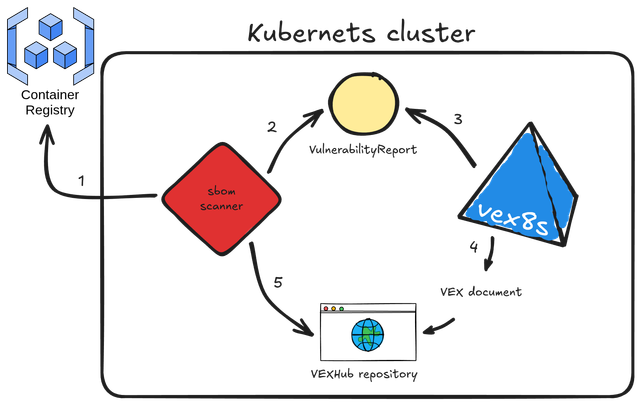
Here's the workflow explained:
- sbomscanner scans for images in registry
- generates a
VulnerabilityReportwith the image CVEs - vex8s-controller triggers when a workload is scheduled on the cluster and generates a VEX document based on the workload
SecurityContextconfiguration - the VEX document is provided by vex8s-controller using a VEX Hub repository
- sbomscanner configure the VEXHub CRD to point to the internal vex8s-controller VEX Hub repository
Goals
The objective is to build a kubernetes controller that uses the vex8s mitigation rules engine to generate VEX documents and serve them through an internal VEX Hub repository within the cluster.
SBOMscanner can then be configured to consume VEX data directly from this in-cluster repository managed by vex8s-controller.
Resources
Summary
The project ended up with this PoC on GitHub: vex8s-controller.
The controller works fine, but needs work to make it more stable. Instructions to reproduce a demo locally are reported in the repository.