
Overview
With the recent explosion of product extensions, modules, bases, the decomposition of monolithic base products into modules, and the amount of churn in product composition between releases, the task of calculating product dependencies and migrations between products has approached the complexity of package management. We have a state of the art tool for solving package dependencies, so why not apply it to the new domain?
Documentation on libsolv
https://en.opensuse.org/images/b/b9/Fosdem2008-solver.pdf https://en.opensuse.org/openSUSE:Libzypp_satsolver https://doc.opensuse.org/projects/satsolver/HEAD/ https://github.com/openSUSE/libsolv/tree/master/doc https://github.com/openSUSE/libsolv/blob/master/doc/libsolv-bindings.txt
Related efforts
https://github.com/rh-lab-q/remote-dependency-solving/tree/master/src/server https://fedoramagazine.org/remote-dependency-solving-cloud-computing/

This project is part of:
Hack Week 17
Activity
Comments
-

over 7 years ago by wstephenson | Reply
NB coolo has a script in /suse/coolo/list_modules using this approach already.
-

over 7 years ago by Pharaoh_Atem | Reply
There was also an experiment into server-side generic dependency solving, with an article about it by Fedora Magazine.
Similar Projects
Recipes catalog and calculator in Rails 8 by gfilippetti
My wife needs a website to catalog and sell the products of her upcoming bakery, and I need to learn and practice modern Rails. So I'm using this Hack Week to build a modern store using the latest Ruby on Rails best practices, ideally up to the deployment.
TO DO
- Index page
- Product page
- Admin area -- Supplies calculator based on orders -- Orders notification
- Authentication
- Payment
- Deployment
Day 1
As my Rails knowledge was pretty outdated and I had 0 experience with Turbo (wich I want to use in the app), I started following a turbo-rails course. I completed 5 of 11 chapters.
Day 2
Continued the course until chapter 8 and added live updates & an empty state to the app. I should finish the course on day 3 and start my own project with the knowledge from it.
Hackweek 25
For this Hackweek I'll continue this project, focusing on a Catalog/Calculator for my wife's recipes so she can use for her Café.
Day 1
MCP Server for SCC by digitaltomm
Description
Provide an MCP Server implementation for customers to access data on scc.suse.com via MCP protocol. The core benefit of this MCP interface is that it has direct (read) access to customer data in SCC, so the AI agent gets enhanced knowledge about individual customer data, like subscriptions, orders and registered systems.
Architecture
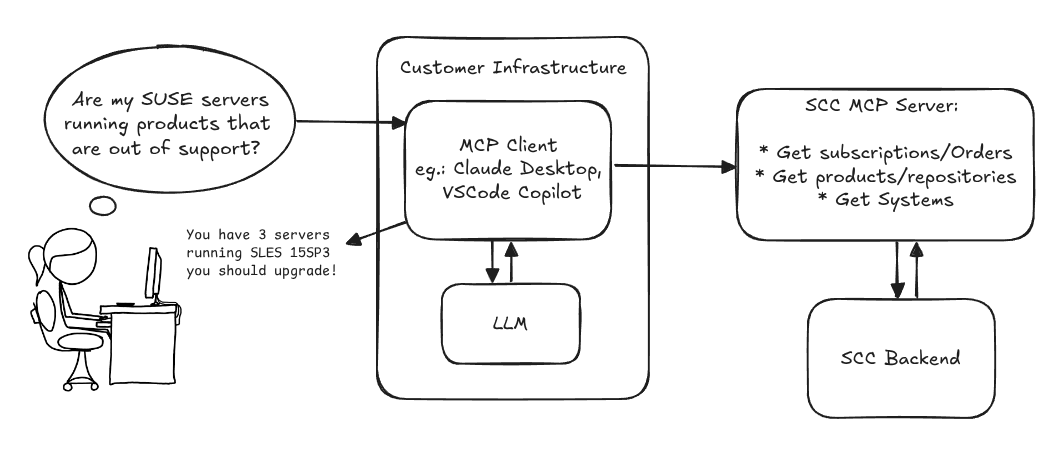
Goals
We want to demonstrate a proof of concept to connect to the SCC MCP server with any AI agent, for example gemini-cli or codex. Enabling the user to ask questions regarding their SCC inventory.
For this Hackweek, we target that users get proper responses to these example questions:
- Which of my currently active systems are running products that are out of support?
- Do I have ready to use registration codes for SLES?
- What are the latest 5 released patches for SLES 15 SP6? Output as a list with release date, patch name, affected package names and fixed CVEs.
- Which versions of kernel-default are available on SLES 15 SP6?
Technical Notes
Similar to the organization APIs, this can expose to customers data about their subscriptions, orders, systems and products. Authentication should be done by organization credentials, similar to what needs to be provided to RMT/MLM. Customers can connect to the SCC MCP server from their own MCP-compatible client and Large Language Model (LLM), so no third party is involved.
Milestones
[x] Basic MCP API setup
  MCP endpoints
  [x] Products / Repositories
  [x] Subscriptions / Orders
  [x] Systems
  [x] Packages
[x] Document usage with Gemini CLI, Codex
Resources
Gemini CLI setup:
~/.gemini/settings.json: