Description
As the user-space NFS provider, the NFS-Ganesha is wieldy use with serval projects. e.g. Longhorn/Rook. We want to create the Kubernetes Controller to make configuring NFS-Ganesha easy. This controller will let users configure NFS-Ganesha through different backends like VFS/CephFS.
Goals
- Create NFS-Ganesha Package on OBS: nfs-ganesha5, nfs-ganesha6
- Create NFS-Ganesha Container Image on OBS: Image
- Create a Kubernetes controller for NFS-Ganesha and support the VFS configuration on demand. Mammuthus
Resources

Looking for hackers with the skills:
This project is part of:
Hack Week 24
Activity
Comments
Be the first to comment!
Similar Projects
Arcticwolf - A rust based user space NFS server by vcheng
Description
Rust has similar performance to C. Also, have a better async IO module and high integration with io_uring. This project aims to develop a user-space NFS server based on Rust.
Goals
- Get an understanding of how cargo works
- Get an understanding of how XDR was generated with xdrgen
- Create the RUST-based NFS server that supports basic operations like mount/readdir/read/write
Result (2025 Hackweek)
- In progress PR: https://github.com/Vicente-Cheng/arcticwolf/pull/1
Resources
https://github.com/Vicente-Cheng/arcticwolf
Play with the userfaultfd(2) system call and download on demand using HTTP Range Requests with Golang by rbranco
Description
The userfaultfd(2) is a cool system call to handle page faults in user-space. This should allow me to list the contents of an ISO or similar archive without downloading the whole thing. The userfaultfd(2) part can also be done in theory with the PROT_NONE mprotect + SIGSEGV trick, for complete Unix portability, though reportedly being slower.
Goals
- Create my own library for userfaultfd(2) in Golang.
- Create my own library for HTTP Range Requests.
- Complete portability with Unix.
- Benchmarks.
- Contribute some tests to LTP.
Resources
- https://docs.kernel.org/admin-guide/mm/userfaultfd.html
- https://www.cons.org/cracauer/cracauer-userfaultfd.html
SUSE Health Check Tools by roseswe
SUSE HC Tools Overview
A collection of tools written in Bash or Go 1.24++ to make life easier with handling of a bunch of tar.xz balls created by supportconfig.
Background: For SUSE HC we receive a bunch of supportconfig tar balls to check them for misconfiguration, areas for improvement or future changes.
Main focus on these HC are High Availability (pacemaker), SLES itself and SAP workloads, esp. around the SUSE best practices.
Goals
- Overall improvement of the tools
- Adding new collectors
- Add support for SLES16
Resources
csv2xls* example.sh go.mod listprodids.txt sumtext* trails.go README.md csv2xls.go exceltest.go go.sum m.sh* sumtext.go vercheck.py* config.ini csvfiles/ getrpm* listprodids* rpmdate.sh* sumxls* verdriver* credtest.go example.py getrpm.go listprodids.go sccfixer.sh* sumxls.go verdriver.go
docollall.sh* extracthtml.go gethostnamectl* go.sum numastat.go cpuvul* extractcluster.go firmwarebug* gethostnamectl.go m.sh* numastattest.go cpuvul.go extracthtml* firmwarebug.go go.mod numastat* xtr_cib.sh*
$ getrpm -r pacemaker
>> Product ID: 2795 (SUSE Linux Enterprise Server for SAP Applications 15 SP7 x86_64), RPM Name:
+--------------+----------------------------+--------+--------------+--------------------+
| Package Name | Version                    | Arch   | Release      | Repository         |
+--------------+----------------------------+--------+--------------+--------------------+
| pacemaker    | 2.1.10+20250718.fdf796ebc8 | x86_64 | 150700.3.3.1 | sle-ha/15.7/x86_64 |
| pacemaker    | 2.1.9+20250410.471584e6a2  | x86_64 | 150700.1.9   | sle-ha/15.7/x86_64 |
+--------------+----------------------------+--------+--------------+--------------------+
Total packages found: 2
Q2Boot - A handy QEMU VM launcher by amanzini
Description
Q2Boot (Qemu Quick Boot) is a command-line tool that wraps QEMU to provide a streamlined experience for launching virtual machines. It automatically configures common settings like KVM acceleration, virtio drivers, and networking while allowing customization through both configuration files and command-line options.
The project originally was a personal utility in D, now recently rewritten in idiomatic Go. It lives at repository https://github.com/ilmanzo/q2boot
Goals
Improve the project, testing with different scenarios , address issues and propose new features. It will benefit of some basic integration testing by providing small sample disk images.
Updates
- Dec 1, 2025 : refactor command line options, added structured logging. Released v0.0.2
- Dec 2, 2025 : added external monitor via telnet option
- Dec 4, 2025 : released v0.0.3 with architecture auto-detection
- Dec 5, 2025 : filing new issues and general polishment. Designing E2E testing
Resources
Create a go module to wrap happy-compta.fr by cbosdonnat
Description
https://happy-compta.fr is a tool for french work councils simple book keeping. While it does the job, it has no API to work with and it is tedious to enter loads of operations.
Goals
Write a go client module to be used as an API to programmatically manipulate the tool.
Writing an example tool to load data from a CSV file would be good too.
terraform-provider-feilong by e_bischoff
Project Description
People need to test operating systems and applications on s390 platform. While this is straightforward with KVM, this is very difficult with z/VM.
IBM Cloud Infrastructure Center (ICIC) harnesses the Feilong API, but you can use Feilong without installing ICIC(see this schema).
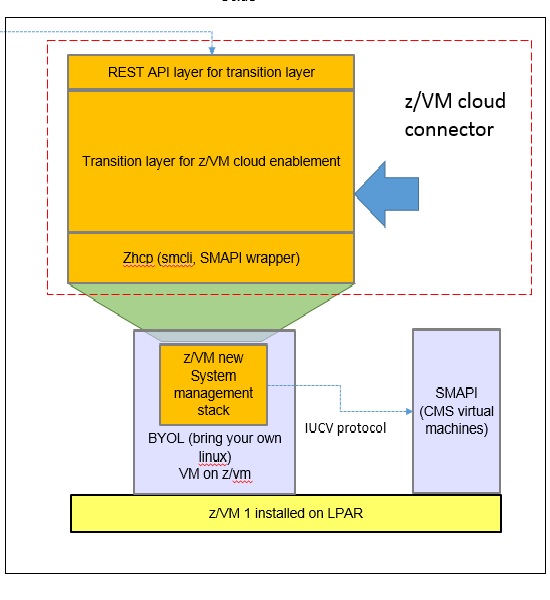
What about writing a terraform Feilong provider, just like we have the terraform libvirt provider? That would allow to transparently call Feilong from your main.tf files to deploy and destroy resources on your z/VM system.
Goal for Hackweek 23
I would like to be able to easily deploy and provision VMs automatically on a z/VM system, in a way that people might enjoy even outside of SUSE.
My technical preference is to write a terraform provider plugin, as it is the approach that involves the least software components for our deployments, while remaining clean, and compatible with our existing development infrastructure.
Goals for Hackweek 24
Feilong provider works and is used internally by SUSE Manager team. Let's push it forward!
Let's add support for fiberchannel disks and multipath.
Goals for Hackweek 25
Modernization, maturity, and maintenance: support for SLES 16 and openTofu, new API calls, fixes...
Resources
Outcome
Exploring Modern AI Trends and Kubernetes-Based AI Infrastructure by jluo
Description
Build a solid understanding of the current landscape of Artificial Intelligence and how modern cloud-native technologies—especially Kubernetes—support AI workloads.
Goals
Use Gemini Learning Mode to guide the exploration, surface relevant concepts, and structure the learning journey:
- Gain insight into the latest AI trends, tools, and architectural concepts.
- Understand how Kubernetes and related cloud-native technologies are used in the AI ecosystem (model training, deployment, orchestration, MLOps).
Resources
Red Hat AI Topic Articles
- https://www.redhat.com/en/topics/ai
Kubeflow Documentation
- https://www.kubeflow.org/docs/
Q4 2025 CNCF Technology Landscape Radar report:
- https://www.cncf.io/announcements/2025/11/11/cncf-and-slashdata-report-finds-leading-ai-tools-gaining-adoption-in-cloud-native-ecosystems/
- https://www.cncf.io/wp-content/uploads/2025/11/cncfreporttechradar_111025a.pdf
Agent-to-Agent (A2A) Protocol
- https://developers.googleblog.com/en/a2a-a-new-era-of-agent-interoperability/
OpenPlatform Self-Service Portal by tmuntan1
Description
In SUSE IT, we developed an internal developer platform for our engineers using SUSE technologies such as RKE2, SUSE Virtualization, and Rancher. While it works well for our existing users, the onboarding process could be better.
To improve our customer experience, I would like to build a self-service portal to make it easy for people to accomplish common actions. To get started, I would have the portal create Jira SD tickets for our customers to have better information in our tickets, but eventually I want to add automation to reduce our workload.
Goals
- Build a frontend website (Angular) that helps customers create Jira SD tickets.
- Build a backend (Rust with Axum) for the backend, which would do all the hard work for the frontend.
Resources (SUSE VPN only)
- development site: https://ui-dev.openplatform.suse.com/login?returnUrl=%2Fopenplatform%2Fforms
- https://gitlab.suse.de/itpe/core/open-platform/op-portal/backend
- https://gitlab.suse.de/itpe/core/open-platform/op-portal/frontend
Self-Scaling LLM Infrastructure Powered by Rancher by ademicev0
Self-Scaling LLM Infrastructure Powered by Rancher

Description
The Problem
Running LLMs can get expensive and complex pretty quickly.
Today there are typically two choices:
- Use cloud APIs like OpenAI or Anthropic. Easy to start with, but costs add up at scale.
- Self-host everything - set up Kubernetes, figure out GPU scheduling, handle scaling, manage model serving... it's a lot of work.
What if there was a middle ground?
What if infrastructure scaled itself instead of making you scale it?
Can we use existing Rancher capabilities like CAPI, autoscaling, and GitOps to make this simpler instead of building everything from scratch?
Project Repository: github.com/alexander-demicev/llmserverless
What This Project Does
A key feature is hybrid deployment: requests can be routed based on complexity or privacy needs. Simple or low-sensitivity queries can use public APIs (like OpenAI), while complex or private requests are handled in-house on local infrastructure. This flexibility allows balancing cost, privacy, and performance - using cloud for routine tasks and on-premises resources for sensitive or demanding workloads.
A complete, self-scaling LLM infrastructure that:
- Scales to zero when idle (no idle costs)
- Scales up automatically when requests come in
- Adds more nodes when needed, removes them when demand drops
- Runs on any infrastructure - laptop, bare metal, or cloud
Think of it as "serverless for LLMs" - focus on building, the infrastructure handles itself.
How It Works
A combination of open source tools working together:
Flow:
- Users interact with OpenWebUI (chat interface)
- Requests go to LiteLLM Gateway
- LiteLLM routes requests to:
- Ollama (Knative) for local model inference (auto-scales pods)
- Or cloud APIs for fallback
Rancher/k8s Trouble-Maker by tonyhansen
Project Description
When studying for my RHCSA, I found trouble-maker, which is a program that breaks a Linux OS and requires you to fix it. I want to create something similar for Rancher/k8s that can allow for troubleshooting an unknown environment.
Goals for Hackweek 25
- Update to modern Rancher and verify that existing tests still work
- Change testing logic to populate secrets instead of requiring a secondary script
- Add new tests
Goals for Hackweek 24 (Complete)
- Create a basic framework for creating Rancher/k8s cluster lab environments as needed for the Break/Fix
- Create at least 5 modules that can be applied to the cluster and require troubleshooting
Resources
- https://github.com/celidon/rancher-troublemaker
- https://github.com/rancher/terraform-provider-rancher2
- https://github.com/rancher/tf-rancher-up
- https://github.com/rancher/quickstart
The Agentic Rancher Experiment: Do Androids Dream of Electric Cattle? by moio
Rancher is a beast of a codebase. Let's investigate if the new 2025 generation of GitHub Autonomous Coding Agents and Copilot Workspaces can actually tame it. 
The Plan
Create a sandbox GitHub Organization, clone in key Rancher repositories, and let the AI loose to see if it can handle real-world enterprise OSS maintenance - or if it just hallucinates new breeds of Kubernetes resources!
Specifically, throw "Agentic Coders" some typical tasks in a complex, long-lived open-source project, such as:
❥ The Grunt Work: generate missing GoDocs, unit tests, and refactorings. Rebase PRs.
❥ The Complex Stuff: fix actual (historical) bugs and feature requests to see if they can traverse the complexity without (too much) human hand-holding.
❥ Hunting Down Gaps: find areas lacking in docs, areas of improvement in code, dependency bumps, and so on.
If time allows, also experiment with Model Context Protocol (MCP) to give agents context on our specific build pipelines and CI/CD logs.
Why?
We know AI can write "Hello World." and also moderately complex programs from a green field. But can it rebase a 3-month-old PR with conflicts in rancher/rancher? I want to find the breaking point of current AI agents to determine if and how they can help us to reduce our technical debt, work faster and better. At the same time, find out about pitfalls and shortcomings.
The CONCLUSION!!!
A  State of the Union document was compiled to summarize lessons learned this week. For more gory details, just read on the diary below!