
 grog
grog
Project Description
grog aims to implements a namespaced, distributed map kept alive by an arbitrary number of nodes over a local network.
It uses TCP and UDP multicast.
For a detailed specification see grog's github repository
grog can be implemented in any programming language.
It deals with networking problems in a distributed cluster.
- Possibly useful when developing a distributed application.
- Not designed to be used in production.
- Not meant to be efficient in space.
- Immediate usage.
- Zero network configuration.
- No data definition.
- Arbitrary complex type for values.
- json as unique value's format.
- Small operation set to access and manipulate the map:
get, to get the value of a key from a mapset, to add or update the value of a key in a mapdel, to remove a key, value pair from a map
- Integrable in programs where an implementation for that language exists.
Goal for this Hackweek
Play with Go programming language.
Try to provide a minimum viable deamon and CLI written in Go.
Resources
I'm looking for people interested in networking protocols and networking problems.
: : : : : : : : : : :

Looking for hackers with the skills:
This project is part of:
Hack Week 21
Activity
Comments
Be the first to comment!
Similar Projects
Cluster API Provider for Harvester by rcase
Project Description
The Cluster API "infrastructure provider" for Harvester, also named CAPHV, makes it possible to use Harvester with Cluster API. This enables people and organisations to create Kubernetes clusters running on VMs created by Harvester using a declarative spec.
The project has been bootstrapped in HackWeek 23, and its code is available here.
Work done in HackWeek 2023
- Have a early working version of the provider available on Rancher Sandbox : *DONE *
- Demonstrated the created cluster can be imported using Rancher Turtles: DONE
- Stretch goal - demonstrate using the new provider with CAPRKE2: DONE and the templates are available on the repo
DONE in HackWeek 24:
- Add more Unit Tests
- Improve Status Conditions for some phases
- Add cloud provider config generation
- Testing with Harvester v1.3.2
- Template improvements
- Issues creation
DONE in 2025 (out of Hackweek)
- Support of ClusterClass
- Add to
clusterctlcommunity providers, you can add it directly withclusterctl - Testing on newer versions of Harvester v1.4.X and v1.5.X
- Support for
clusterctl generate cluster ... - Improve Status Conditions to reflect current state of Infrastructure
- Improve CI (some bugs for release creation)
Goals for HackWeek 2025
- FIRST and FOREMOST, any topic is important to you
- Add e2e testing
- Certify the provider for Rancher Turtles
- Add Machine pool labeling
- Add PCI-e passthrough capabilities.
- Other improvement suggestions are welcome!
Thanks to @isim and Dominic Giebert for their contributions!
Resources
Looking for help from anyone interested in Cluster API (CAPI) or who wants to learn more about Harvester.
This will be an infrastructure provider for Cluster API. Some background reading for the CAPI aspect:
Play with the userfaultfd(2) system call and download on demand using HTTP Range Requests with Golang by rbranco
Description
The userfaultfd(2) is a cool system call to handle page faults in user-space. This should allow me to list the contents of an ISO or similar archive without downloading the whole thing. The userfaultfd(2) part can also be done in theory with the PROT_NONE mprotect + SIGSEGV trick, for complete Unix portability, though reportedly being slower.
Goals
- Create my own library for userfaultfd(2) in Golang.
- Create my own library for HTTP Range Requests.
- Complete portability with Unix.
- Benchmarks.
- Contribute some tests to LTP.
Resources
- https://docs.kernel.org/admin-guide/mm/userfaultfd.html
- https://www.cons.org/cracauer/cracauer-userfaultfd.html
Rewrite Distrobox in go (POC) by fabriziosestito
Description
Rewriting Distrobox in Go.
Main benefits:
- Easier to maintain and to test
- Adapter pattern for different container backends (LXC, systemd-nspawn, etc.)
Goals
- Build a minimal starting point with core commands
- Keep the CLI interface compatible: existing users shouldn't notice any difference
- Use a clean Go architecture with adapters for different container backends
- Keep dependencies minimal and binary size small
- Benchmark against the original shell script
Resources
- Upstream project: https://github.com/89luca89/distrobox/
- Distrobox site: https://distrobox.it/
- ArchWiki: https://wiki.archlinux.org/title/Distrobox
HTTP API for nftables by crameleon
Background
The idea originated in https://progress.opensuse.org/issues/164060 and is about building RESTful API which translates authorized HTTP requests to operations in nftables, possibly utilizing libnftables-json(5).
Originally, I started developing such an interface in Go, utilizing https://github.com/google/nftables. The conversion of string networks to nftables set elements was problematic (unfortunately no record of details), and I started a second attempt in Python, which made interaction much simpler thanks to native nftables Python bindings.
Goals
- Find and track the issue with google/nftables
- Revisit and polish the Go or Python code (prefer Go, but possibly depends on implementing missing functionality), primarily the server component
- Finish functionality to interact with nftables sets (retrieving and updating elements), which are of interest for the originating issue
- Align test suite
- Packaging
Resources
- https://git.netfilter.org/nftables/tree/py/src/nftables.py
- https://git.com.de/Georg/nftables-http-api (to be moved to GitHub)
- https://build.opensuse.org/package/show/home:crameleon:containers/pytest-nftables-container
Results
- Started new https://github.com/tacerus/nftables-http-api.
- First Go nftables issue was related to set elements needing to be added with different start and end addresses - coincidentally, this was recently discovered by someone else, who added a useful helper function for this: https://github.com/google/nftables/pull/342.
- Further improvements submitted: https://github.com/google/nftables/pull/347.
Side results
Upon starting to unify the structure and implementing more functionality, missing JSON output support was noticed for some subcommands in libnftables. Submitted patches here as well:
- https://lore.kernel.org/netfilter-devel/20251203131736.4036382-2-georg@syscid.com/T/#u
Add support for todo.sr.ht to git-bug by mcepl
Description
I am a big fan of distributed issue tracking and the best (and possibly) only credible such issue tracker is now git-bug. It has bridges to another centralized issue trackers, so user can download (and modify) issues on GitHub, GitLab, Launchpad, Jira). I am also a fan of SourceHut, which has its own issue tracker, so I would like it bridge the two. Alas, I don’t know much about Go programming language (which the git-bug is written) and absolutely nothing about GraphQL (which todo.sr.ht uses for communication). AI to the rescue. I would like to vibe code (and eventually debug and make functional) bridge to the SourceHut issue tracker.
Goals
Functional fix for https://github.com/git-bug/git-bug/issues/1024
Resources
- anybody how actually understands how GraphQL and authentication on SourceHut (OAuth2) works
Contribute to terraform-provider-libvirt by pinvernizzi
Description
The SUSE Manager (SUMA) teams' main tool for infrastructure automation, Sumaform, largely relies on terraform-provider-libvirt. That provider is also widely used by other teams, both inside and outside SUSE.
It would be good to help the maintainers of this project and give back to the community around it, after all the amazing work that has been already done.
If you're interested in any of infrastructure automation, Terraform, virtualization, tooling development, Go (...) it is also a good chance to learn a bit about them all by putting your hands on an interesting, real-use-case and complex project.
Goals
- Get more familiar with Terraform provider development and libvirt bindings in Go
- Solve some issues and/or implement some features
- Get in touch with the community around the project
Resources
- CONTRIBUTING readme
- Go libvirt library in use by the project
- Terraform plugin development
- "Good first issue" list
SUSE Health Check Tools by roseswe
SUSE HC Tools Overview
A collection of tools written in Bash or Go 1.24++ to make life easier with handling of a bunch of tar.xz balls created by supportconfig.
Background: For SUSE HC we receive a bunch of supportconfig tar balls to check them for misconfiguration, areas for improvement or future changes.
Main focus on these HC are High Availability (pacemaker), SLES itself and SAP workloads, esp. around the SUSE best practices.
Goals
- Overall improvement of the tools
- Adding new collectors
- Add support for SLES16
Resources
csv2xls* example.sh go.mod listprodids.txt sumtext* trails.go README.md csv2xls.go exceltest.go go.sum m.sh* sumtext.go vercheck.py* config.ini csvfiles/ getrpm* listprodids* rpmdate.sh* sumxls* verdriver* credtest.go example.py getrpm.go listprodids.go sccfixer.sh* sumxls.go verdriver.go
docollall.sh* extracthtml.go gethostnamectl* go.sum numastat.go cpuvul* extractcluster.go firmwarebug* gethostnamectl.go m.sh* numastattest.go cpuvul.go extracthtml* firmwarebug.go go.mod numastat* xtr_cib.sh*
$ getrpm -r pacemaker
>> Product ID: 2795 (SUSE Linux Enterprise Server for SAP Applications 15 SP7 x86_64), RPM Name:
+--------------+----------------------------+--------+--------------+--------------------+
| Package Name | Version                    | Arch   | Release      | Repository         |
+--------------+----------------------------+--------+--------------+--------------------+
| pacemaker    | 2.1.10+20250718.fdf796ebc8 | x86_64 | 150700.3.3.1 | sle-ha/15.7/x86_64 |
| pacemaker    | 2.1.9+20250410.471584e6a2  | x86_64 | 150700.1.9   | sle-ha/15.7/x86_64 |
+--------------+----------------------------+--------+--------------+--------------------+
Total packages found: 2
Rewrite Distrobox in go (POC) by fabriziosestito
Description
Rewriting Distrobox in Go.
Main benefits:
- Easier to maintain and to test
- Adapter pattern for different container backends (LXC, systemd-nspawn, etc.)
Goals
- Build a minimal starting point with core commands
- Keep the CLI interface compatible: existing users shouldn't notice any difference
- Use a clean Go architecture with adapters for different container backends
- Keep dependencies minimal and binary size small
- Benchmark against the original shell script
Resources
- Upstream project: https://github.com/89luca89/distrobox/
- Distrobox site: https://distrobox.it/
- ArchWiki: https://wiki.archlinux.org/title/Distrobox
Play with the userfaultfd(2) system call and download on demand using HTTP Range Requests with Golang by rbranco
Description
The userfaultfd(2) is a cool system call to handle page faults in user-space. This should allow me to list the contents of an ISO or similar archive without downloading the whole thing. The userfaultfd(2) part can also be done in theory with the PROT_NONE mprotect + SIGSEGV trick, for complete Unix portability, though reportedly being slower.
Goals
- Create my own library for userfaultfd(2) in Golang.
- Create my own library for HTTP Range Requests.
- Complete portability with Unix.
- Benchmarks.
- Contribute some tests to LTP.
Resources
- https://docs.kernel.org/admin-guide/mm/userfaultfd.html
- https://www.cons.org/cracauer/cracauer-userfaultfd.html
terraform-provider-feilong by e_bischoff
Project Description
People need to test operating systems and applications on s390 platform. While this is straightforward with KVM, this is very difficult with z/VM.
IBM Cloud Infrastructure Center (ICIC) harnesses the Feilong API, but you can use Feilong without installing ICIC(see this schema).
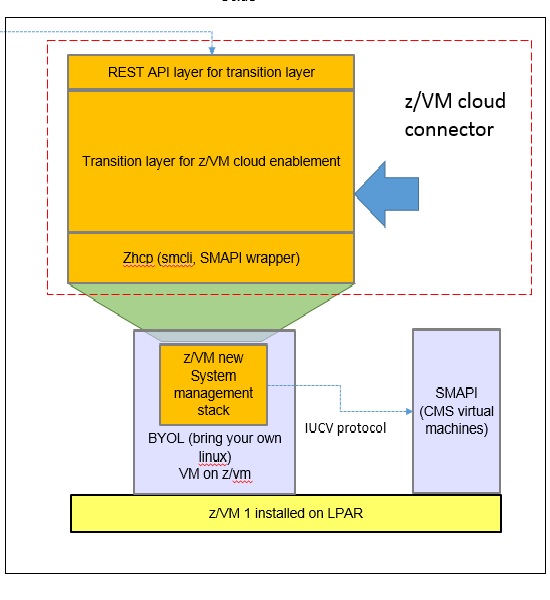
What about writing a terraform Feilong provider, just like we have the terraform libvirt provider? That would allow to transparently call Feilong from your main.tf files to deploy and destroy resources on your z/VM system.
Goal for Hackweek 23
I would like to be able to easily deploy and provision VMs automatically on a z/VM system, in a way that people might enjoy even outside of SUSE.
My technical preference is to write a terraform provider plugin, as it is the approach that involves the least software components for our deployments, while remaining clean, and compatible with our existing development infrastructure.
Goals for Hackweek 24
Feilong provider works and is used internally by SUSE Manager team. Let's push it forward!
Let's add support for fiberchannel disks and multipath.
Goals for Hackweek 25
Modernization, maturity, and maintenance: support for SLES 16 and openTofu, new API calls, fixes...
Resources
Outcome
Hacking a SUSE MLS 7.9 Cluster by roseswe
Description
SUSE MLS (Multi-Linux Support) - A subscription where SUSE provides technical support and updates for Red Hat Enterprise Linux (RHEL) and CentOS servers
The most significant operational difference between SUSE MLS 7 and the standard SUSE Linux Enterprise Server High Availability Extension (SLES HAE) lies in the administrative toolchain. While both distributions rely on the same underlying Pacemaker resource manager and Corosync messaging layer, MLS 7 preserves the native Red Hat Enterprise Linux 7 user space. Consequently, MLS 7 administrators must utilize the Pacemaker Configuration System (pcs), a monolithic and imperative tool. The pcs utility abstracts the entire stack, controlling Corosync networking, cluster bootstrapping, and resource management through single-line commands that automatically generate the necessary configuration files. In contrast, SLES HAE employs the Cluster Resource Management Shell (crmsh). The crm utility operates as a declarative shell that focuses primarily on the Cluster Information Base (CIB). Unlike the command-driven nature of pcs, crmsh allows administrators to enter a configuration context to define the desired state of the cluster using syntax that maps closely to the underlying XML structure. This makes SLES HAE more flexible for complex edits but requires a different syntax knowledge base compared to the rigid, command-execution workflow of MLS 7.
Scope is here MLS 7.9
Goals
- Get more familiar with MLS7.9 HA toolchain and Graphical User Interface and Daemons
- Create a two node MLS cluster with SBD
- Check different use cases
- Create a "SUSE Best Practices" presentation slide set suitable for Consulting Customers
Resources
- You need MLS7.9 (Qcow2) installed + subscription
- KVM server with 2 KVMs, 2 SBD
- RHEL7 and HA skills
Work on kqlite (Lightweight remote SQLite with high availability and auto failover). by epenchev
Description
Continue the work on kqlite (Lightweight remote SQLite with high availability and auto failover).
It's a solution for applications that require High Availability but don't need all the features of a complete RDBMS and can fit SQLite in their use case.
Also kqlite can be considered to be used as a lightweight storage backend for K8s (https://docs.k3s.io/datastore) and the Edge, and allowing to have only 2 Nodes for HA.
Goals
Push kqlite to a beta version.
kqlite as library for Go programs.
Resources
https://github.com/kqlite/kqlite
Add a machine-readable output to dmidecode by jdelvare
Description
There have been repeated requests for a machine-friendly dmidecode output over the last decade. During Hack Week 19, 5 years ago, I prepared the code to support alternative output formats, but didn't have the time to go further. Last year, Jiri Hnidek from Red Hat Linux posted a proof-of-concept implementation to add JSON output support. This is a fairly large pull request which needs to be carefully reviewed and tested.
Goals
Review Jiri's work and provide constructive feedback. Merge the code if acceptable. Evaluate the costs and benefits of using a library such as json-c.